Implementing an AI Usage Policy: Protecting Data Privacy and Pushing New Safeguards
Introduction:
Generative AI tools like OpenAI’s ChatGPT and Anthropic’s Claude have rapidly become everyday aids for writing, coding, and research. In many organizations, employees are already using these AI systems in their workflow sometimes without management’s knowledge or the consent of those whose data might be involved. For example, one recent report describes an employee hurriedly pasting sections of a client contract (including real client names) into ChatGPT, and another typing their company login credentials into an AI assistant to “see what happens” digitalinformationworld.com. In both cases, sensitive information was handed to a third-party AI service. These scenarios are not isolated. Surveys show that a significant share of professionals have fed confidential data into AI tools, unaware of the risks digitalinformationworld.com. This trend has prompted urgent calls for companies, especially small and mid-sized businesses to establish clear AI usage policies. Such policies can protect personal and confidential data (PII, PHI, trade secrets), ensure compliance with privacy laws, and guide employees in reaping AI’s benefits responsibly. In this comprehensive overview, we examine how staff are using AI (often without oversight), the privacy and security dangers of unchecked AI use, and key policy measures organizations should implement now to mitigate these risks.
Employees Are Using AI Without Oversight, A Growing Risk
AI chatbots have been embraced remarkably fast. By early 2023, ChatGPT reached 100 million users, and it is now integrated in many workplace tasks lcwlegal.com. It’s likely that some of your staff are already using AI tools on the job, whether officially sanctioned or not lcwlegal.com. Recent data confirms this: over one in four professionals (26%) admit to entering sensitive company information into generative AI tools, and nearly one in five have even submitted their login credentials to an AI system digitalinformationworld.com. Alarmingly, almost 1 in 10 workers confess they’ve lied to their employer about using AI at work digitalinformationworld.com, indicating some employees are aware their AI use might not be approved. In other cases, employees might simply be “confused” , thinking a consumer AI chatbot is a safe, approved tool , and inadvertently upload confidential data debevoisedatablog.com.
In the absence of clear guidance, well-intentioned employees can easily overstep privacy boundaries. They might use ChatGPT to summarize meeting notes or translate a client report, not realizing that anything they input could be stored or even seen by the AI provider. Indeed, OpenAI’s standard policies allow it to retain chat entries for at least 30 days and use them to improve models (for non-API users) hipaajournal.com. That means any text an employee enters , a customer’s email, a patient’s symptoms, source code, etc. , might linger on external servers outside your control. One prominent example occurred at Samsung: engineers pasted proprietary source code into ChatGPT, inadvertently exposing sensitive code to the public (since the AI retained the info) mcdonaldhopkins.com. The result? Samsung banned employees from using ChatGPT and similar AI tools altogether to protect its intellectual property mcdonaldhopkins.com.
Without a policy in place, employees may also be violating client or patient trust by sharing data with AI services without consent. If staff feed customer personal details or health information to an AI, the individuals behind that data have not authorized such use. This raises serious ethical and legal issues. In fact, privacy regulators have started taking notice , for instance, in 2023 Italy even temporarily banned ChatGPT over privacy concerns until safeguards were addressed mcdonaldhopkins.com. All these factors point to a critical gap: AI adoption is outpacing the policies and training needed to use it safely. A recent survey underscores this gap, finding that 70% of workers have had no formal training on safe AI use, and 44% say their employer has no official AI policy at all digitalinformationworld.com. This “wild west” of AI usage in the workplace is a ticking time bomb for data breaches and compliance violations.
Privacy Dangers: PII, PHI, and Confidential Data at Risk
One of the most urgent concerns is the exposure of sensitive personal data. When employees put personally identifiable information (PII) or protected health information (PHI) into a public AI model, that information can become part of the model’s data repository or fall into the wrong hands. In plain terms, inputting sensitive data to ChatGPT is akin to posting it on a public website , it’s no longer within your private domain lcwlegal.com. There have already been instances of workers inadvertently disclosing PII/PHI or other confidential details while using ChatGPT mcdonaldhopkins.com. For example, an employee might paste a spreadsheet of customer phone numbers and addresses to get formatting help, or a doctor might ask ChatGPT to draft a letter that includes patient health details. If those entries contain identifiers (names, emails, Social Security numbers, health conditions, etc.), they become part of the AI’s stored conversation logs. This creates a permanent leak of data: the organization has effectively handed private information to an outside entity without any control over its use or retention.
From a legal and compliance standpoint, this is perilous. In healthcare, for instance, using ChatGPT with PHI is outright non-compliant with HIPAA unless you have a special business agreement. OpenAI will not sign the required Business Associate Agreement (BAA) with health providers, meaning ChatGPT is not HIPAA-compliant out of the box hipaajournal.comhipaajournal.com. Any use of ChatGPT with patient-identifiable information could be a direct HIPAA violation hipaajournal.com. The only safe way to leverage such AI in healthcare is to completely de-identify the data (remove all personal identifiers) before input, so that no actual PHI is disclosed hipaajournal.com. In practice, that is a high bar to clear , it requires stripping names, dates, addresses, and any other traceable detail. Similar principles apply to other industries: a financial firm could breach privacy laws (or its own client contracts) if an employee pastes client transaction data into an AI, and a business subject to GDPR could violate data transfer rules by sending EU personal data to a U.S.-based AI service without safeguards.
Even beyond regulatory fines, the reputational damage from a data leak via AI can be severe. If clients discover their information was unknowingly shared with an AI platform, trust erodes. There’s also the risk that the data could resurface. Remember that anything entered into a public AI might later emerge in another user’s output due to AI training or prompt leaks. Indeed, a ChatGPT bug in March 2023 briefly exposed snippets of other users’ conversations (including payment info) to random people metomic.io. While that bug was patched, it highlights that data put into an AI can inadvertently become visible to others. Malicious actors could also target AI systems: if employees are routinely inputting secrets, hackers have a new “prompt leakage” surface to exploit digitalinformationworld.comdigitalinformationworld.com.
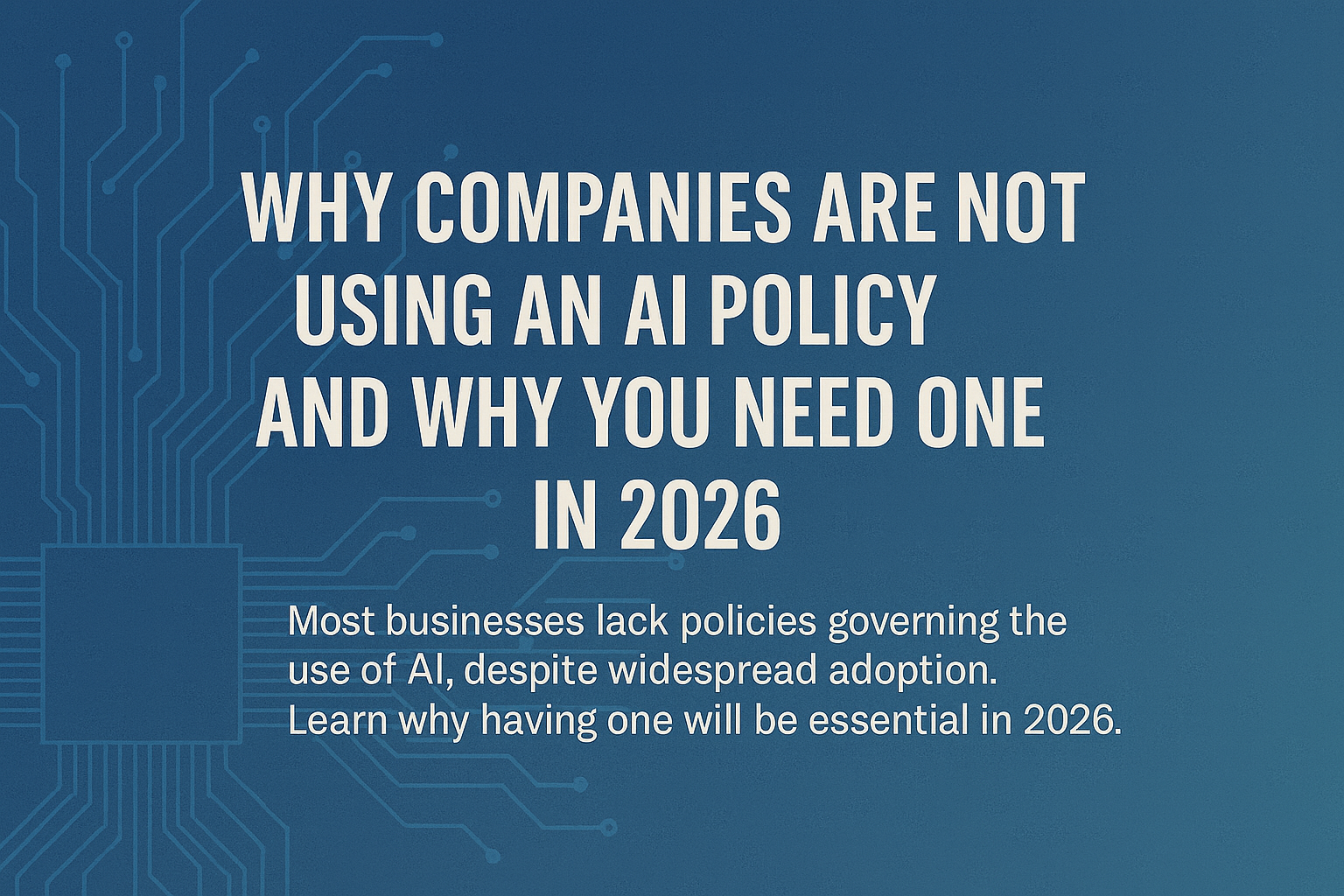
The Case for an AI Usage Policy , Now, Not Later
Given the above risks, it’s clear that organizations cannot afford to take a laissez-faire approach to employee AI use. Yet many have delayed action. One study found 69% of organizations view AI-driven data leaks as a top concern, but nearly half have no specific security controls or policies for AI in place metomic.io. This disconnect between concern and action is dangerous. Every week that passes without guidelines is another week where an unwitting employee might expose confidential data or create legal liabilities.
Instituting an AI usage policy (and related training) is the proactive solution. A well-crafted policy does several things: it educates employees about the do’s and don’ts of AI at work, it sets clear boundaries on what can/cannot be shared, and it establishes oversight and accountability. Such a policy isn’t about stifling innovation , it’s about setting “guardrails” for safe AI use so that employees can still benefit from these tools without endangering the company or its clients. As one legal advisory puts it, employers should establish clear, thorough, and consistently applied policies for AI use, which are adaptable as the technology evolves lcwlegal.com. The goal is to bridge the current gap: right now policies and training lag behind AI adoption, leaving employees unsure how to use AI without “breaking rules or risking data” digitalinformationworld.com. A policy closes that gap by spelling out the rules.
Moreover, having a formal policy signals to your staff (and to clients/regulators) that you take data protection seriously even as you embrace new tech. It can also foster an open dialogue: employees might be more likely to ask before using AI on a sensitive project if guidelines are clearly published, rather than hiding their AI usage. In fact, 8% of professionals admitted they continued to use ChatGPT at work even after being told not to digitalinformationworld.com , a sign that outright bans without explanation don’t work. It’s better to permit safe uses with proper safeguards than to ignore the issue or issue unenforced edicts. Ultimately, the time to implement an AI policy is now , before a costly incident occurs, not after.
Key Guidelines for a Responsible AI Use Policy
When drafting an AI usage policy for your organization, several core elements should be included. Below are key guidelines and guardrails that experts recommend every policy cover:
- No Uploading of Confidential or Personal Data: Employees should be strictly prohibited from inputting any confidential, sensitive, or personally identifiable information into external AI tools lcwlegal.com. This includes customer data, patient information, financial records, source code, trade secrets, and any PII/PHI such as names, contact info, Social Security numbers, health details, etc. A good rule of thumb is to treat any information given to an AI as if it will be made public lcwlegal.com. If a use case requires AI processing of such data, the data must be thoroughly anonymized or stripped of identifiers first (e.g. use placeholders for names) hipaajournal.com. Example: Rather than pasting an actual client email, an employee could replace real names and remove contact details before asking the AI to draft a response.
- Approved Tools and Environments: Clarify which AI tools or platforms are permitted for work use. Preference should be given to enterprise-grade solutions that offer data privacy safeguards, such as those that don’t retain data or that operate in a sandboxed environment. For instance, some companies use the Azure OpenAI Service or ChatGPT Enterprise, which promise not to use inputs for training and provide encryption and access control. If your company has a custom or self-hosted AI model, employees should use that over public chatbots. Any use of unapproved AI services should require management approval. The policy might state that AI tools need vetting by IT or security teams to ensure they meet privacy and compliance requirements. By steering staff toward safer tools, you minimize “shadow AI” usage on random websites.
- Accuracy and Accountability of Outputs: Make it clear that AI-generated content may not be assumed correct. Employees must verify any AI outputs used for business decisions, external communications, or calculations lcwlegal.comlcwlegal.com. AI can produce convincing but incorrect or fabricated results (known as hallucinations). A notorious case involved a lawyer who used ChatGPT to write a legal brief, only to find the AI had fabricated case law citations , leading to embarrassment and sanctions lcwlegal.com. To avoid such mishaps, the policy can instruct employees to use AI as a drafting or brainstorming aid, but not as a final authority. Workers should double-check facts, and any content that will be delivered to clients or published should undergo normal review processes. In short, employees remain accountable for the accuracy and appropriateness of any AI-assisted work.
- Training and Awareness: Incorporate AI usage into your employee training programs. Since 70% of employees report no formal training on safe AI use digitalinformationworld.com, there’s an immediate need to educate your workforce. Training should cover the policy itself, real-world examples of AI risks (like those mentioned earlier), and how to properly handle data. Emphasize concepts like “prompt hygiene” , e.g. don’t include unnecessary personal details in your AI prompts digitalinformationworld.com , and teach staff to recognize where AI can safely assist versus where it should not be applied. By improving AI literacy, employees are less likely to misuse the tools or fall for AI-related pitfalls (such as believing everything the AI says or exposing credentials). Consider requiring a brief certification or acknowledgement that employees understand the AI policy.
- Monitoring and Enforcement: Lastly, outline how the company will monitor AI usage and enforce the rules. This might involve technical measures (for example, IT deploying filters that block employees from entering certain types of data into AI web forms digitalinformationworld.com, or scanning prompts for keywords like “SSN” or client names). Some enterprises are adopting data loss prevention (DLP) tools adapted for AI, which can catch PII or other regulated info in prompts digitalinformationworld.com. The policy could also state that using AI in violation of these guidelines may lead to disciplinary action. However, enforcement should go hand-in-hand with support: encourage employees to seek guidance if unsure about using AI for a task, rather than going underground. Creating an “AI governance committee” or point of contact (with members from IT, legal, and compliance) can provide a resource for questions and continuously update the policy as needed digitalinformationworld.com. Remember, the aim is not to punish people for curiosity, but to protect the organization and its stakeholders from harm.
Conclusion: Act Now to Harness AI Safely
AI tools are here to stay, and their use in the workplace will only expand. A small or mid-sized business might be tempted to let employees experiment freely, especially given the productivity gains AI can offer. Yet, as we’ve seen, ignoring the need for AI governance is a high-stakes gamble. The question is not if an employee will mishandle sensitive data with AI, but when , unless you put proper policies in place. By instituting a clear AI usage policy now, organizations can enjoy the efficiencies of AI while sidestepping its pitfalls. The policy acts as a seatbelt: it doesn’t stop the journey, but it helps ensure you arrive safely without a costly crash.
In summary, companies should immediately define how staff may use AI, train employees on these expectations, and deploy technical safeguards to back them up. Key priorities include preventing any unauthorized exposure of PII/PHI or confidential info, and maintaining compliance with all privacy regulations in the age of AI. As one set of experts advised, treat every AI prompt as “data in motion” and design your controls around it, rather than leaving it to chance digitalinformationworld.com. With a robust policy and a culture of responsible innovation, your team can leverage cutting-edge AI tools with confidence and integrity , enhancing productivity without compromising trust or security. The organizations that act now to set these guardrails will be far better positioned to navigate our AI-driven future than those that hesitate and react only after a breach or blunder. Your staff may already be using AI, with or without permission; it’s time to convert that hidden risk into a well-governed advantage.